
The FT reports on the arrangements to finance Anthropic’s June 2026 delivery of $35bn worth of tensor processing units (TPUs) purchased from Google. TPUs are powerful computers optimized for matrix multiplication, and are being deployed now to perform the calculations behind AI services. TPUs are measured by the flow of electricity they consume: $35bn bought Anthropic 1GW, comparable to the output of a large nuclear reactor.
The June delivery is just one tranche of a larger agreement to supply 3.5GW of capacity, and that in turn is just one company’s purchases of compute—a whole industry is doing the same. Putting all the intricacies of large language models aside, it is helpful to think of this as capital investment on a large scale; like all capital investments, it is paid for with borrowed money. And, as the FT reports, the financial arrangements are complex, with more than a whiff of circularity.
Follow the money, as usual
Let’s spell out more clearly the series of financial relationships behind Anthropic’s TPU deal. For new readers: the best way to reason about finance at a high level is with T accounts—each entity’s balance sheet in two columns, assets to the left and liabilities to the right. This view of the financing agreements abstracts away from various parts of the real world: the transaction is shown in logically coherent stages, though in reality they are not cleanly sequenced; it is shown without dollar amounts; it shows assets and liabilities in economic substance, which is not necessarily the same way that a professional accountant would record it. To wit, in two parts:
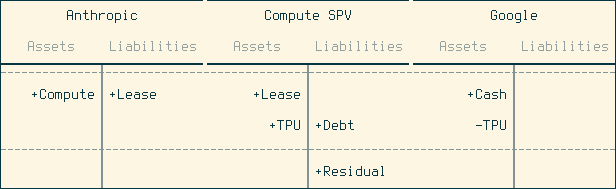
The T accounts above mostly capture the material side of the transaction. Google sells tensor processing units to Compute SPV, a legal entity set up just for this transaction. The SPV enters into a lease agreement with Anthropic; I record this as an asset for Compute SPV, which expects a series of incoming lease payments (comparable to receiving bond coupon payments), and as a liability to Anthropic, which expects to make those same payments (comparable to a loan). The reason Anthropic is doing this is so that it will have access to computing power, which I show as an asset, specifically referring to Anthropic’s access to the future flow of compute services, the ability to run those TPUs to do whatever it wants. The purchase of TPUs makes sense for Anthropic if it can transform compute into valuable services and sell those services for more than its lease payments back to the SPV.
The SPV buys the TPUs now and leases them to Anthropic: when the lease is up, or if Anthropic stops paying for some other reason, the TPUs will still be worth something (minimum: scrap value), which I record as residual value, an equity-like entry recorded on the liability side of the balance sheet. It’s not immediately clear from the reporting where this residual sits legally, although the lawyers of Anthropic, Google, Apollo and Blackstone would all certainly argue that it’s not theirs. I return to this point below.
The TPUs are expensive up front, but can be operated for a long time—this is the characteristic time profile of any capital asset. The key financing problem posed by this time profile is how to cover the up-front cost until the compute services can be sold, since those buying capital goods usually don’t have the money lying around. Here, the financing problem is solved on the balance sheet of Compute SPV, which buys the TPUs from Google with debt issued today and repaid over time with funds from the incoming lease payments from Anthropic. Compute SPV is shown again here, now with its financial relationships:
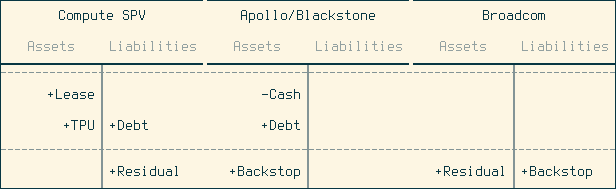
Notably, the funds that make the whole thing possible today come from Apollo and Blackstone. These giants of private credit seem to find reassurance in the presence of a backstop agreement from Broadcom, designer of the TPUs that Google is selling. In this transaction, Broadcom agrees to make the lenders whole should the SPV default. I capture the economic substance of the backstop as a liability entry for Broadcom and so an asset for the lenders. The actual value of this backstop ranges from zero, if Anthropic never defaults, to $30bn, should Broadcom have to cover everything. The backstop is balanced on Broadcom’s balance sheet by Compute SPV’s residual: the TPUs are the container of economic value in the whole transaction, and so that is the credibility on which Broadcom’s guarantee rests.
Caveat emptor, as usual
There are two main sticking points. The first is the payment constraint on Anthropic: the company has to sell AI services in order to make its lease payments. In this sense, the entire capital expenditure is keyed off of the expectation that future sales of the services generated by operating these TPUs will yield cash inflows sufficient to cover the payments. This belief, in turn, should be viewed in context with the fact everyone else is making the same investment at the same time: this deal is a representative example.
The second is that the backstop that makes the whole thing go comes from Broadcom, which in partnership with Google is also a seller in the same transaction. As always with backstops, the question must be: “is the backstop credible?” Broadcom’s commitment is that it will make bondholders whole in the event that Compute SPV is unable to do so; Compute SPV’s income in turn comes from its lease agreement with Anthropic, so it is really Anthropic that is the beneficiary of the backstop. The backstop is not needed if Anthropic succeeds at selling AI services at a price sufficient to make its lease payments as agreed. Only if Anthropic’s revenues fall short will Broadcom’s guarantee be activated.
The transaction is based, that is, on a vision of the future in which Anthropic can’t sell AI services, but Broadcom, a designer of chips that enable AI services, has funds to pay out on what is effectively a credit-default swap. As usual.